
Jan 28
/
James Kavanagh
Creating your AI Risk Management Policy
How to structure an AI Risk Management Policy that makes risk identification, assessment, and treatment part of everyday organisational practice.
AI Risk Management Policy Template
Originally published 14th April 2025.
Update note: This article has been substantially revised based on research and analysis undertaken for the AI Governance Practitioner Program's course on Writing AI Governance Policies (Course 4). This updated version reflects the structured approach developed in that course, which includes a comprehensive policy template that you can download and adapt. If you're looking for more depth on any of the concepts covered here, the full course provides detailed tutorials, worked examples, and practical exercises.
Four previous articles have ventured across the landscape of AI risk, from categorising different types of risks, identifying them in your systems, assessing their priority, to selecting the right controls. Now we've arrived at the final step: bringing it all together into a cohesive policy that your organisation can implement. In this article, I'm going to run through what it takes to build an AI Risk Management Policy, one that complements both the AI Governance Policy and AI Use Policy that together form your governance foundation. I'm hoping to help you create a policy that doesn't just sit around gathering digital dust, that instead proves to be a living document that people across your organisation consult, update, and most importantly, implement.
From Principles to Practice
When I work with teams implementing AI governance, I've found a clear pattern: organisations that successfully manage AI risks don't treat their policy as a compliance checkbox. Instead, they treat it as something like an operational manual, a translation aid from high-level principles into day-to-day practices.
Understanding where this policy fits within your broader governance framework matters. Your AI Governance Policy establishes the strategic questions of who holds authority and why AI matters to your organisation. Your AI Use Policy translates governance principles into practical guidance that every employee can understand and apply. Your AI Risk Management Policy sits between these, zeroing in on the tactical question of how you'll manage risk. It's the difference between declaring "we'll use AI responsibly" and specifying exactly how you'll spot emerging threats, measure their potential impact, and implement controls before they can cause harm.
This separation keeps all three documents focused and allows your risk management practices to evolve more quickly than your fundamental governance structure. If you've been following along with our previous discussions on categorising risks, identification techniques like pre-mortems and red-teaming, and assessment approaches, you already have the building blocks. Now we're creating the framework that makes these insights part of your everyday organisational practice.
The guidance here is aimed at medium to large organisations that both use and develop AI systems. It assumes you have at least some dedicated governance capacity and that you're managing a portfolio of AI systems with varying risk profiles. If you're a smaller organisation primarily adopting AI tools rather than building them, the principles still apply, but you may want a more streamlined approach that combines elements from all three policies into a single document. I've made a downloadable policy template available for those who want a starting point, but focus on understanding the thinking behind each component rather than implementing any template exactly as written.
Your risk management policy shouldn't try to extend beyond the scope of what it takes to do AI risk management. You won't need anything here about your overall AI strategy, budgets, or broad ethical principles. Those aspects belong elsewhere in your governance framework, primarily in your AI Governance Policy. Instead, focus on giving your teams a structured way to think about risk: how to identify it systematically, track it continuously, mitigate it effectively, and keep it within acceptable boundaries as your AI systems evolve and interact with the real world.
You can learn how to write your Risk Management Policy with a complete template that you can adapt and usein your organisation. It's all within Course 4 of the AI Governance Practitioner Program
Setting clear scope boundaries for your risk policy
When I think through the right scope for an AI Risk Management Policy, I aim for something both comprehensive and focused. It should be broad enough to cover your entire AI landscape, yet specific enough that people know exactly when and how to apply it.
The policy should apply to any meaningful interaction with AI technology, whether you're building a new model from scratch, fine-tuning a large language model, or simply deploying an off-the-shelf solution. However, this doesn't mean applying the same intensity of risk process to every AI initiative regardless of its context. Instead, the policy should scale with the risk profile, allowing teams to appropriately adjust their risk management based on specific criteria and review mechanisms. This "impact-based scaling of requirements" is central to making governance proportionate rather than burdensome.
In practical terms, your policy should cover any AI system that could potentially process sensitive or personal data that could harm individuals if mishandled, make or influence significant decisions affecting customers, employees, or business operations, scale to a point where failures could create legal, reputational, or financial consequences, or interact dynamically with users or other systems in ways that could evolve unpredictably.
A well-scoped policy won't become a bureaucratic barrier to innovation. I've seen cases where AI projects go "underground" to avoid cumbersome governance processes. Think through for your own context an approach that creates a sliding scale, where the intensity of risk management correlates with potential harm. A prototype chatbot used by three people in your R&D team doesn't need the same scrutiny as an algorithm determining customer credit worthiness, but both should fall within the policy's scope, with the latter simply triggering significantly more intensive risk assessment and controls.
I generally encourage teams to err on the side of inclusion when defining scope. Start with the assumption that an AI initiative requires risk management, then create clear pathways to "right-size" the process based on the actual risk profile. This prevents dangerous blind spots where seemingly innocuous systems might harbour significant risks that go unexamined. At the same time, it creates a proportionate approach where teams don't waste resources over-analysing systems with minimal risk potential.
Remember that scope isn't just about which systems are covered. It's also about defining the boundaries between this policy and other organisational policies. Your AI Risk Management Policy shouldn't duplicate or conflict with enterprise risk management processes, cybersecurity frameworks, or data protection requirements. Instead, it needs to complement them, focusing specifically on the unique risks that emerge from AI systems' learning capabilities, opacity, and potential for unexpected behaviours.
Definitions: Speaking the same language of risk
Promising risk initiatives can unravel simply because different teams don't agree on what "high risk" actually means. One person's "significant risk" might be another's "moderate concern," leading to misaligned expectations and inconsistent responses. That's why a clear set of definitions forms the foundation of any effective risk management approach.
When crafting definitions for your AI Risk Management Policy, focus on those terms that consistently create confusion in cross-functional conversations. I'm not suggesting you build an exhaustive dictionary. That would make the document unwieldy and less likely to be referenced. Instead, prioritise clarity around those concepts that often lead to misunderstandings.
Four core terms warrant particular attention. Risk itself is the combination of the likelihood of an event and its potential consequences that could adversely affect the organisation's objectives or cause harm to stakeholders. Risk Appetite is the level of risk the organisation is willing to accept in pursuit of its strategic objectives. Risk Tolerance provides the acceptable thresholds around the organisation's risk appetite for specific categories of AI risk. And the Risk Register is the centralised repository where identified risks, their assessments, and their respective controls are recorded and maintained.
Beyond these basics, two additional concepts capture what makes AI risk distinctive. Risk Velocity refers to the speed at which AI risks can unfold and affect an organisation once triggered. AI systems often exhibit faster risk development than traditional technologies due to automated decision-making, feedback loops, and network effects that can amplify problems rapidly. Dynamic Feedback Effects describe the potential for AI risks to self-amplify or create cascading failures through model feedback loops, emergent behaviours, or unexpected interactions with other systems. These effects require special consideration because they can cause moderate risks to compound into severe ones if left unchecked.
Most organisations already have some form of enterprise-wide risk terminology, so don't reinvent the wheel. It's useful to reference existing frameworks where appropriate, whether that's ISO 42001, NIST's AI Risk Management Framework, or your company's established risk glossary. The key is ensuring that AI-specific risk concepts integrate smoothly with your broader risk language, and that the policy is unambiguous. If your enterprise defines risk levels on a five-point scale, maintain that consistency rather than creating a separate three-point system just for AI risks.
I've seen confusion over definitions extend to seemingly unending policy debates. For example, some have argued that the EU AI Act's focus on "risk as potential harm" conflicts with ISO standards' broader definition of risk as "uncertainty on objectives," leading them to conclude that ISO-based approaches cannot possibly align with the EU AI Act's conformance requirements. Yes, they are different. But in practice, if it looks like a duck and quacks like a duck, it's a duck. If something looks and acts like a risk, it is a risk. Whether we call it "harm" or "uncertainty on objectives," the outcome is the same: we still need robust mechanisms to identify, assess, and manage anything that jeopardises safety, compliance, or performance. Try to cut through the noise and confusion caused by different definitions from external documents. Instead, define terms as you need them to be interpreted within your organisation.
Making a statement
The Policy Statement is a concise, clear declaration of your organisation's approach to AI risk. While your AI Governance Policy might establish broad principles like accountability, transparency, and human oversight, your AI Risk Management Policy Statement needs to be more precise.
A good policy statement commits to managing AI-related risks "proactively and transparently throughout the system lifecycle." Both qualifiers matter. Proactive means you're identifying and addressing risks before they materialise, not just responding to incidents after harm occurs. Transparent means risk information flows to those who need it rather than being buried in technical documentation that leadership never sees. Throughout the system lifecycle means risk management doesn't end at deployment. It continues through operation, modification, and eventual retirement.
The statement should tie all AI systems to "risk evaluation aligned with the organisation's risk appetite and tolerance levels." This creates the binding constraint that connects individual system assessments to organisational strategy. Teams can't define their own comfort levels. They work within boundaries that leadership has established.
Notice what your Policy Statement shouldn't include. Avoid aspirational language about innovation or competitive advantage. Don't list AI benefits to balance against the risk focus. Keep the statement firmly on what the organisation commits to regarding risk management. Other documents can make the case for AI's value. This policy focuses on protection.
If your organisation has a formal enterprise risk appetite statement, this is the perfect place to reference it, showing how AI risk management nests within your broader risk framework. The policy statement should also reflect your organisation's unique context and priorities. If you operate in a heavily regulated industry like healthcare or financial services, emphasise how regulatory compliance forms a non-negotiable baseline for all AI initiatives. If your business strategy emphasises rapid innovation, acknowledge how risk management supports rather than hinders that goal, enabling sustainable innovation by preventing costly missteps.
When drafting this section, keep it short. The Policy Statement should fit in a single paragraph. If you find yourself writing multiple paragraphs of commitment language, you're probably duplicating content that belongs elsewhere in the policy or in your Governance Policy's principles section.
Risk appetite and tolerance
One of the most important elements of your policy addresses risk appetite and tolerance explicitly. This is where you translate abstract risk philosophy into concrete guidance that shapes real decisions.
Your Risk Appetite Statement should acknowledge both the transformative potential of AI and the inherent risks associated with advanced data-driven technologies. It needs to articulate where your organisation sits on the spectrum from conservative to aggressive. A "moderate risk" appetite, for example, means the organisation is open to adopting AI solutions that offer substantial operational or strategic benefits, provided that associated risks are clearly identified, assessed, and effectively controlled. You'll need to calibrate this to your own organisation's circumstances, but having an explicit statement creates the foundation for consistent decision-making.
More practically useful are the Risk Tolerance Levels that provide clarity on how much risk is acceptable within specific categories. Consider establishing tolerance levels across five areas:
-
For Regulatory and Legal Compliance, most organisations need minimal tolerance. You will not engage in AI activities that carry a high risk of violating applicable laws or regulations. This is typically non-negotiable.
-
For Data Privacy and Security, a low tolerance emphasises strong data governance practices. Use of personal or sensitive data in AI systems must follow stringent privacy and security controls.
-
For Ethical and Reputational Impact, a low to moderate tolerance means AI systems that could result in significant ethical dilemmas or reputational damage must undergo thorough review and require approval from senior governance bodies.
-
For Operational Disruption, a moderate tolerance allows a reasonable level of experimentation with AI solutions, but projects that present a high risk of severe operational disruption are subject to heightened controls and monitoring.
-
For Unanticipated Costs, a moderate to high tolerance accepts a reasonable level of unforeseen or non-recoverable costs associated with AI experimentation, including pilot initiatives that may not result in immediate business value. This tolerance supports innovation, provided such costs are pre-approved within defined budgets.
These categories aren't exhaustive, and you may need to add or modify them based on your specific context. What matters is that you've made explicit what was previously implicit, so teams can make decisions that align with organisational expectations rather than guessing at what leadership might find acceptable.
System impact classification
Closely related to risk appetite is the system of impact classification that determines how much governance oversight any particular AI system requires. This is where you operationalise proportionality.
A three-tier classification system works well for most organisations. All AI systems should be classified according to their potential impact before deployment, and this classification determines the level of governance oversight, documentation, and control required throughout the system lifecycle.
-
Low Impact systems provide advisory outputs with human decision-making, process non-sensitive data, affect limited populations, and present minimal potential for harm. These systems follow streamlined governance pathways while meeting baseline requirements for registration and responsible use..
-
Medium Impact systems influence significant decisions, process personal or sensitive data, operate at meaningful scale, or present moderate potential for harm if they malfunction or produce biased outputs. These systems require formal risk assessment, documented controls, and validation prior to deployment.
-
High Impact systems make or substantially determine consequential decisions affecting rights, safety, financial standing, or access to essential services. This includes systems operating autonomously in high-stakes contexts, processing highly sensitive data at scale, falling under regulatory high-risk designation, or presenting significant potential for serious harm. These systems require executive-level approval, comprehensive risk treatment plans, extended validation, and ongoing post-deployment review.
Classification should consider factors including the consequence and reversibility of decisions the system makes or influences, the degree of human oversight, the scale of affected individuals, the sensitivity of data processed, applicable regulatory requirements, and whether the system's outputs affect vulnerable groups. Importantly, classification must be reviewed whenever the system's scope, use, or operating environment changes materially.
This classification approach creates different paths based on initial risk screening. A low-risk or skunkworks AI project might follow a streamlined process with basic documentation, while high-risk initiatives trigger more intensive assessment, multiple approval gates, and mandatory controls. You need to be explicit about when a skunkworks project becomes a mission-critical application, with the expectation of more thorough risk management processes to kick in beforehand.
The risk management framework
Now we come to the bridge between conceptual understanding and concrete action, showing exactly how risk management integrates into the lifecycle of every AI initiative. Be aware that it is often better to thoughtfully extend existing risk frameworks to address AI's unique characteristics. If your organisation already uses a risk register for tracking enterprise risks, your AI Risk Management Policy should explain how AI risks feed into that same system, perhaps with additional AI-specific metadata or assessment criteria that capture distinctive risk velocity and dynamic feedback effects.
It's all about creating clear, repeatable processes that team members can follow without having to reinvent the wheel each time. Your framework should cover risk identification, assessment, treatment, monitoring, and continuous improvement.
During concept and planning, teams should perform initial risk identification using techniques like pre-mortem simulations or incident pattern mining, categorising potential risks and establishing preliminary risk scores. This early assessment should influence fundamental design choices, including whether to proceed with development and what architecture or approach minimises inherent risk.
As development progresses, risk assessment deepens through more rigorous techniques like dependency analysis or adversarial testing, with findings documented in the risk register and informing specific control requirements before deployment can be approved.
Post-deployment, ongoing monitoring and periodic reviews help ensure that risks haven't evolved beyond their assessed levels, with clear thresholds for when changes in model behaviour, usage patterns, or external environments trigger reassessment.
Most importantly, the policy must specify concrete artifacts and decision points. What documentation must be completed? Who reviews risk assessments? What criteria determine whether additional controls are needed? When is executive approval required? By answering these practical questions, you transform risk management from a fairly vague aspiration into a defined workflow that teams can actually implement.
Three practical lessons emerge from organisations that manage AI risk well. First, treat risk management as enabling innovation rather than constraining it. The goal isn't eliminating risk but keeping it within acceptable boundaries while enabling confident innovation. Second, invest in systematic identification approaches rather than relying on informal brainstorming. Pre-mortem analysis consistently uncovers risks that casual discussion misses. Third, build exception processes from day one. You'll face situations that don't fit your framework almost immediately. Having a formal exception process means you capture these cases, learn from them, and use them to improve your policies.
Creating clear accountabilities
Spelling out who owns each aspect of AI risk management is a crucial operational element of your policy. The most common pitfall I see isn't lack of risk awareness. It's the assumption that "someone else" is handling the risk. Data scientists assume legal teams are addressing compliance risks. Product managers think IT security is covering all technical vulnerabilities. Legal teams think their supplier contracts protect the organisation from toxic content in third party data. Executives believe frontline teams are monitoring for potential harms. Without clear ownership, these gaps become blind spots where significant risks can fester unaddressed.
Your policy should establish a clear governance structure with defined responsibilities at each level.
At the executive level, you need a body that provides strategic oversight for risk management. This group approves or rejects risk acceptance decisions for high impact systems and novel use cases, reviews critical incident reports and lessons learned to verify systemic risks are remediated, resolves disputed impact classifications, and ensures alignment between organisational risk posture and AI deployment strategies. In the governance framework I recommend, this is the AI Governance Committee.
At the operational level, you need a body responsible for day-to-day operation of the risk management framework. This group maintains the AI Risk Register, reviews and confirms risk assessments and impact classifications for medium and high impact systems, evaluates risks escalated due to severity or novelty, publishes guidance on risk identification methods, and reports significant findings and trends to executive oversight. This is the AI Operational Committee.
System Owners are accountable for risk management of their assigned AI systems. They identify and document risks during planning, development, and operation. They propose impact classification. They implement required controls and monitor their effectiveness. They maintain risk documentation and update the Risk Register as circumstances change. And they escalate material risk changes or control failures to operational governance.
Mechanism Owners are accountable for the effective operation of governance mechanisms themselves. They ensure assigned mechanisms operate effectively and meet their intended purpose. They maintain documentation describing how the mechanism functions. They implement and oversee controls embedded within the mechanism. They monitor mechanism performance and recommend improvements based on operational experience.
This clarity serves a vital purpose beyond accountability. It creates natural escalation paths when issues arise. If a data scientist discovers a potential bias problem during testing, they should know exactly who to alert and what response to expect. Without this clarity, concerning findings might remain siloed or addressed too late, especially when teams face deadline pressure.
Putting the policy into practice
I've learned the hard way that even the most thoughtfully designed policy is only as effective as its implementation. You can craft the perfect risk management framework, but if teams don't understand it, if leadership loses interest, or if the policy gathers dust without regular updates, you've missed the opportunity to meaningfully reduce AI risks.
Implementation starts with thoughtful introduction to the organisation. Rather than simply announcing "we have a new policy" via email, think about how to make the rollout an educational opportunity. I've seen successful approaches where organisations develop targeted training for different stakeholder groups. Technical workshops for data scientists include hands-on risk assessment exercises. Executive briefings focus on governance implications. General awareness sessions help everyone understand why AI risk management matters.
What works particularly well is grounding these sessions in real examples, "war stories" from your own organisation or notable public failures that illustrate what can go wrong when risks aren't properly managed. When teams see concrete examples of AI harms rather than abstract possibilities, the importance of risk management becomes immediately clear. I still use the Microsoft Tay chatbot incident, the Australian Robodebt debacle, and the biased Amazon resume review system in training sessions because they vividly demonstrate how AI risks can materialise through data bias or escalate through feedback loops, a concept that might otherwise seem theoretical.
Training requirements should be explicit in your policy. Employees, contractors, and relevant stakeholders involved in AI initiatives need to complete training on the policy and associated guidance. This training should cover the organisation's risk appetite and tolerance, how to recognise and report potential AI risks, and how to apply risk controls and adhere to escalation protocols. Completion of training should be recorded and monitored, and non-completion may result in restricted access to AI development tools, datasets, or production environments until compliance is achieved.
Remember that successful implementation isn't about perfect compliance with every procedural detail. It's about meaningfully reducing AI risks while enabling responsible innovation. If teams are engaging with risk thoughtfully but adapting the process to their specific context, that's honestly more often a sign of healthy adoption rather than concerning deviation.
Keeping the policy alive
A risk management policy that remains static quickly becomes obsolete. AI systems that initially seem well-controlled can develop unexpected behaviours as data patterns shift, user interactions change, or the surrounding environment evolves. A recommendation algorithm that performs flawlessly at launch might gradually develop bias as usage patterns change. These evolving dynamics require ongoing vigilance rather than one-time assessment.
Effective monitoring sets up clear indicators for each significant risk, essentially creating a dashboard showing whether risks remain within acceptable parameters. For technical risks like model drift, these might be quantitative metrics such as distribution shifts or performance degradation. For ethical risks like fairness, you might monitor outcome disparities across protected groups. Define these indicators in advance, establish acceptable thresholds, and create automated alerts when boundaries are approached.
Regular review cycles complement continuous monitoring. I recommend differentiated schedules based on risk levels: quarterly reviews for high-risk systems, semi-annual for moderate risks, and annual for lower-risk applications. These reviews should examine not just whether individual risks remain controlled but whether new risks have emerged. Avoid the classic mistake of performing one all-up risk assessment in a workshop, then forgetting about its findings until after the product launches. That's checkbox compliance, not risk management.
You'll also need a structured exception process. Even the most thoughtful policy can't anticipate every scenario, particularly in a field evolving as rapidly as AI. All exception requests should be documented and submitted to your operational governance body, including a justification of business need, analysis of potential risks, and any compensating controls. Document exceptions in a central registry to prevent gradual erosion of standards through invisible case-by-case deviations. Importantly, exception patterns serve as valuable feedback: if multiple teams find certain requirements impractical, that signals where your policy might need refinement.
Finally, assign responsibility for reviewing the policy itself, at least annually or when prompted by significant changes like new regulations or major incidents. Substantive revisions to risk appetite statements, classification thresholds, or role assignments should be endorsed by executive governance. Track metrics that show whether the policy is actually reducing risk, such as how many risks were identified before deployment and how effectively controls prevented harms. These metrics demonstrate value to leadership and identify areas needing attention during the next review cycle.
From policy document to lasting impact
Throughout this mini-series on AI risk management, I've gone from understanding the unique landscape of AI risks to identifying, assessing, and controlling them. This policy represents the culmination of that journey, bringing those insights together into a structured framework that transforms risk awareness into consistent organisational practice.
What distinguishes true high-integrity AI governance isn't the elegance of its documentation but tangible reduction in harmful outcomes and the enablement of responsible innovation. Your policy should achieve both goals: protecting your organisation and its stakeholders from AI-related harms while creating the confidence to pursue valuable AI opportunities with clear-eyed awareness rather than either reckless optimism or excessive caution.
I've seen firsthand how organisations that develop thoughtful, proportional approaches to AI risk management gain significant advantages. They avoid costly mistakes that damage reputation or trigger regulatory scrutiny. They build greater trust with customers and employees who interact with their AI systems. And perhaps most importantly, they create an environment where technical teams feel empowered to innovate within clear guardrails rather than constrained by fear of unknown risks.
Be aware, implementing this kind of policy requires more than document approval. It needs sustained leadership commitment, resources for training and tools, and consistent messaging that risk management represents a core value rather than administrative overhead. Go back to my previous articles on how to build the business case for AI governance and secure buy-in from leadership if you know what your policy should be, but don't yet have that kind of sponsorship, resource and budget.
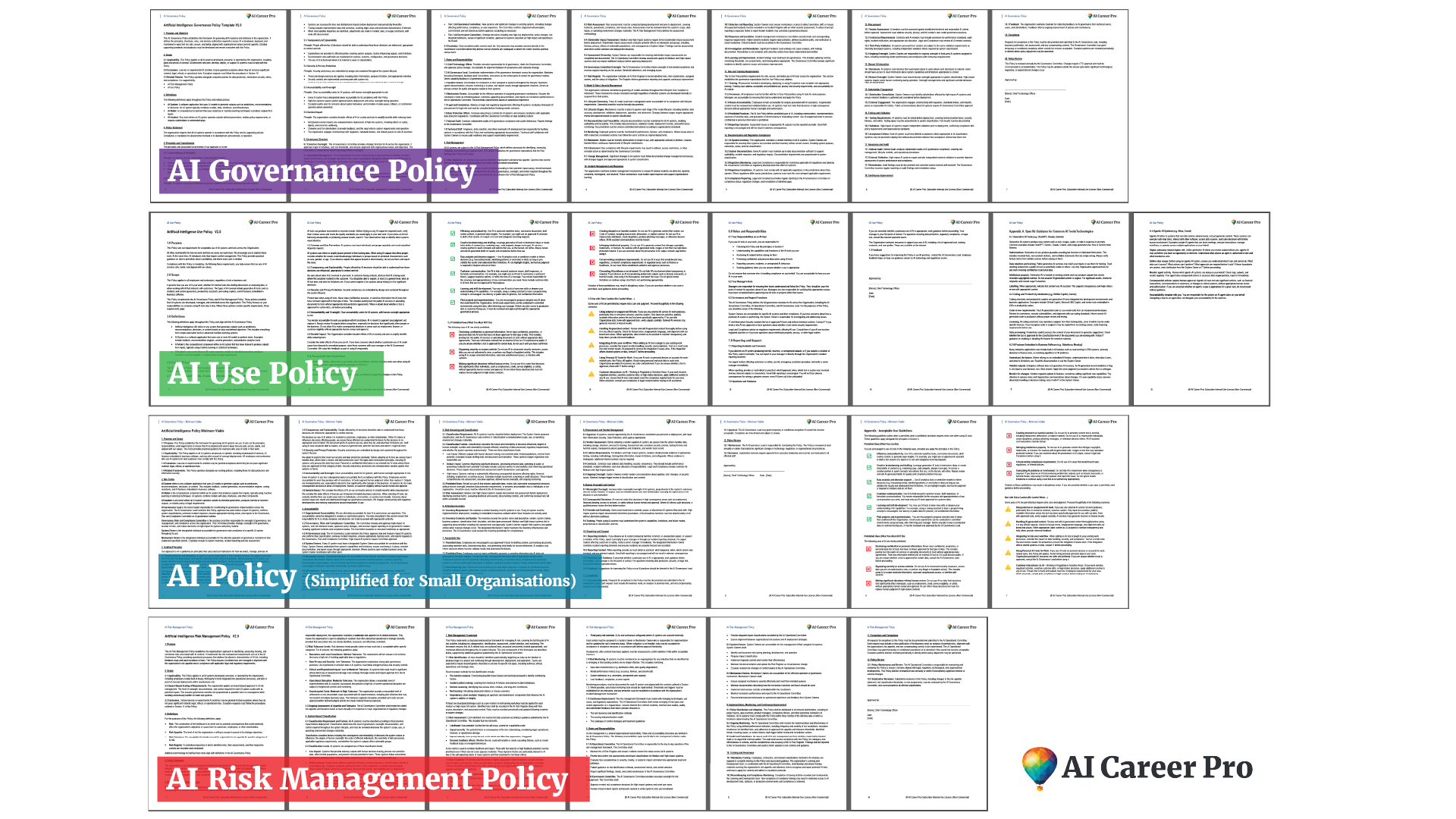
And with that, we conclude our deep dive into AI risk management, a journey that's taken us from understanding risk categories to crafting a comprehensive policy framework. If you want to go further, Course 4 of the AI Governance Practitioner Program walks through each policy section in detail, with video tutorials explaining the reasoning behind every component and how to adapt it to your context. You'll get fully worked templates for your AI Risk Management Policy, AI Governance Policy, and AI Use Policy, all designed to work together as a coherent framework. There's also a streamlined single-policy approach for smaller organisations that don't need the full three-policy architecture. It's the practical toolkit for turning the principles we've covered here into documents your organisation can actually implement.
You can learn how to write effective AI Governance policies with detailed walkthroughs of a Governance Charter, Governance Policy, Risk Management Policy, Use Policy, and even a streamlined AI Policy for small organisations. Download the templates and use them in your organisation. It's all within Course 4 of the AI Governance Practitioner Program
Subscribe to our newsletter!
Our Doing AI Governance newsletter features the latest in AI Governance news, research and expert insights.